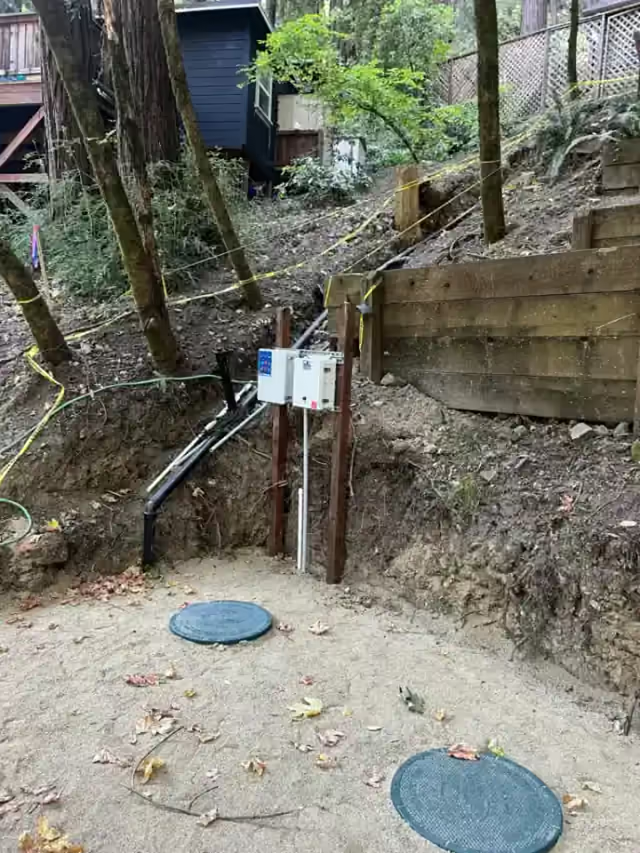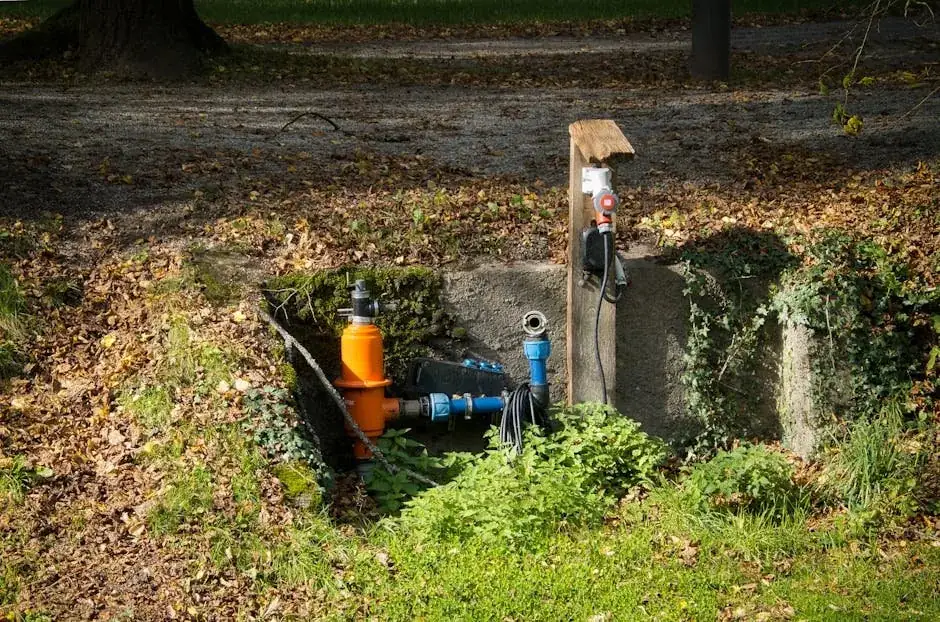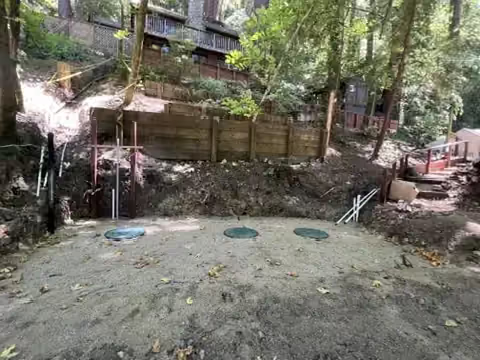
Wade's Plumbing & Septic installs septic systems in Santa Cruz County alongside the project's engineer. Wade's does not pump tanks. A saturated drainfield in the rainy season is usually a water problem first: rain and a high water table fill the soil so household wastewater has nowhere to go. Quotes are free.
Quick answer
A drainfield (also called a leach field) treats wastewater by letting it soak into unsaturated soil. Weeks of Santa Cruz County rain can fill that soil, so the field slows or stops. Keep roof, driveway, and sump water off the field. Watch for soggy ground, odors, or backups that linger after the yard dries. If the field has failed, a replacement in unincorporated Santa Cruz County needs a qualified professional's design and a sewage disposal permit from County Environmental Health. Wade's installs that permitted plan. Wade's does not pump tanks.
- Point downspouts, yard drains, and sump discharge away from the tank and drainfield.
- Fix running toilets and dripping fixtures. Extra indoor water adds to a wet field.
- Spread laundry and showers across the week during long storms.
- Do not drive, park, or run equipment on a wet drainfield.
- Do not have the tank pumped while the drainfield is flooded or saturated.
- Surfacing wastewater, whole-house slow drains, or odors that remain after the rain stops are reasons to have the system evaluated.
The yard-walk checklist lives in our rainy season septic and drain prep guide. This post covers why saturation happens, how to tell a wet field from a failing one, and when a new or replacement system needs an engineer and a county permit.
Why a wet drainfield struggles
A conventional septic system has two main parts: a tank and a drainfield. Solids settle in the tank. Liquid, called effluent, then moves to perforated pipes or chambers in shallow soil. The U.S. EPA describes that soil as the treatment step: it accepts, treats, and disperses the wastewater as it percolates down.
That only works when the soil still has room for water. EPA's drainfield care page is direct: keep roof drains, sump pumps, and other rainwater drainage away from the drainfield, because excess water "slows down or stops the wastewater treatment process." EPA's flood guidance adds the same idea from the other direction. Whenever the water table is high, there is a risk that sewage will back up into the home. The only way to relieve that pressure is to use the system less.
Santa Cruz County's wet months load both sides at once. Rain soaks the yard from above. Groundwater can rise from below. Household water still arrives from the house. On sloped, wooded lots in the San Lorenzo Valley, including Ben Lomond, Boulder Creek, and Felton, runoff also collects in low spots and along cuts. Our post on how Santa Cruz County geography affects septic systems covers why slope, soil, and winter groundwater checks matter here.
A wet field is not automatically a failed field. Many systems slow during a long storm and recover once the soil drains. The job of a homeowner in that stretch is to stop adding extra water, not to dig or empty the tank.
Keep roof and surface water off the leach field
EPA's SepticSmart drainfield rules are the ones that matter in a Santa Cruz winter:
- Roof water. Follow each downspout. If it empties toward the tank or drainfield, extend it or add a splash block so the water leaves that area. Gutters that overflow next to the field are the same problem.
- Sump and yard drains. A groundwater sump pump is not a septic pump. Keep its discharge off the drainfield, as EPA's care page says to do for sump pumps and other rainwater drainage. Point it downhill and away from the field, not into a swale that crosses the trenches. A blocked storm drain can pond water back toward the field until it is cleared.
- Driveways and hillside runoff. Look for a channel of water that crosses the drainfield after a storm. A small berm or swale that sends water around the area can help. On steep or unstable ground, get advice before regrading.
- Weight on wet soil. EPA warns not to drive or operate equipment over a drainfield. Saturated soil compacts easily, which reduces the soil's ability to treat wastewater and can crush pipes.
Do not cover the field with plastic, concrete, or a new patio. EPA notes that impermeable materials cut evaporation and oxygen, which the soil bacteria need.
Inside the house, the same water budget applies. EPA estimates a single leaky or running toilet can add as much as 200 gallons a day. Doing all the laundry in one day can flood a drainfield that is already wet. Spread loads, shorten showers during storm weeks, and keep grease, wipes, and extra food waste out of the tank. A clogged effluent filter can also mimic a failing field.
Signs a drainfield is struggling
County Environmental Health treats an OWTS as having operational problems when there is surfacing effluent, graywater discharging, plumbing backing up into the house, or water-quality problems in nearby resources. EPA's homeowner list matches what people see in the yard:
- Slow drains throughout the house, not just one fixture
- Gurgling in pipes or toilets
- Sewage odors indoors or near the tank or field
- Soggy ground, standing water, or unusually bright green grass over the drainfield that lingers after the rest of the yard has dried
- Wastewater backing up into a tub, shower, or floor drain
- A septic alarm that sounds or stays lit
Some surface moisture right after a storm is normal. Moisture, odor, or lush grass that remains when neighboring soil has dried is the signal. Our posts on signs your drain field needs professional repair and septic leach field repairs go deeper on causes that are not the soil itself: a clogged filter, a failed distribution box, a broken pipe, or a tank that is overdue for emptying.
If sewage is backing up into the house, cut water use as much as you can. A septic inspection or troubleshooting visit can separate a wet-weather slowdown from a field that needs drainfield repair or replacement.
Pumping is not a rainy-season fix. EPA says not to pump a tank while the drainfield is flooded or saturated. At best it is temporary. At worst the empty tank can try to float and damage the inlet and outlet pipes. If the tank is due, schedule emptying while the ground is dry. Wade's does not pump tanks. Book a pumping company for that work. After floodwater has covered the field, see our septic safety during floods guide.
When a new or replacement system needs an engineer and a county permit
Not every drainfield problem is a replacement. Minor maintenance such as replacing sanitary tees, effluent filters, or lids does not need an Environmental Health permit. A minor repair (for example a distribution device, diversion valve, or a re-pipe that does not replace a trench) needs a Minor Repair Permit. A failed field, a replacement trench, or a new system is a major repair or an upgrade, and that path is longer.
Santa Cruz County Environmental Health's OWTS Repair and Repair and Upgrades pages set the split:
- Repair standards apply when the current house does not exceed what the permitted system was sized for (bedrooms and square footage), including the county's one-time habitable-space allowance when no bedrooms are added.
- Upgrade standards apply when the house now has more bedrooms, more habitable space than that allowance, more structures, or an accessory dwelling unit.
- A parcel with no permitted OWTS has to meet current standards for new development.
For a major repair, the first step is a site evaluation. A qualified professional you hire (California civil engineer, professional geologist, certified engineering geologist, or registered environmental health specialist) files that application. Environmental Health staff observe. The evaluation can include soil pits, percolation tests, and wet-weather groundwater checks. Results feed the design.
County qualified professional rules then split the remaining work:
- System design: California registered civil engineer, professional geologist, or registered environmental health specialist (or another professional Environmental Health approves).
- Installation: a contractor licensed by the Contractors State License Board in Class A, Class B, C-36 Plumbing, or C-42 Sanitation System. A Class B holder may install a system only as part of a new construction project.
A sewage disposal permit is required to install, enlarge, replace, modify, repair, abandon, or destroy an OWTS. The application is accepted only when it is complete: the design, scaled plot plan, test results, fees, and any grading, easement, or slope-stability report Environmental Health asks for. On slopes over 30 percent, a technical report is required.
Wade's holds CSLB #1087260 in C-36 Plumbing and C-42 Sanitation System and installs to that permitted plan, including engineered systems when a conventional gravity field will not meet county standards. Wade's does not replace the designer and does not pump tanks. For the full install path, see new septic installations in Santa Cruz County.
Frequently asked questions
Can heavy rain saturate a septic drainfield?
Yes. A drainfield needs unsaturated soil to accept and treat wastewater. Long rain and a high water table fill that space, which slows the system and can lead to slow drains or backups until the soil drains again.
How do I keep roof and yard water off the leach field?
Point downspouts, sump discharge, and yard drains away from the tank and drainfield. Keep cars and equipment off the field, especially when the soil is wet. EPA's drainfield care page is the source for those steps.
How can I tell a wet drainfield from a failing one?
Some moisture right after a storm is expected. Soggy ground, standing water, odors, or unusually green grass that remain after the surrounding yard has dried, or plumbing that backs up into the house, are reasons to have the system evaluated.
Should I have the tank pumped during a storm?
No. EPA advises against pumping while the drainfield is flooded or saturated, because the empty tank can shift. Schedule emptying on dry ground. Wade's does not pump tanks.
When does a replacement drainfield need an engineer and a county permit?
A major repair or replacement in unincorporated Santa Cruz County starts with a site evaluation by a qualified professional, then a design and a sewage disposal permit from Environmental Health. Wade's installs to that permitted plan and does not design the system.
Sources
- U.S. EPA, How to Care for Your Septic System
- U.S. EPA, Do Your Part, Get SepticSmart
- U.S. EPA, Septic Systems: What to Do after the Flood
- Santa Cruz County Environmental Health, OWTS Repair and Upgrades
- Santa Cruz County Environmental Health, OWTS Repair
- Santa Cruz County Environmental Health, Site Evaluation
- Santa Cruz County Environmental Health, Qualified Professionals