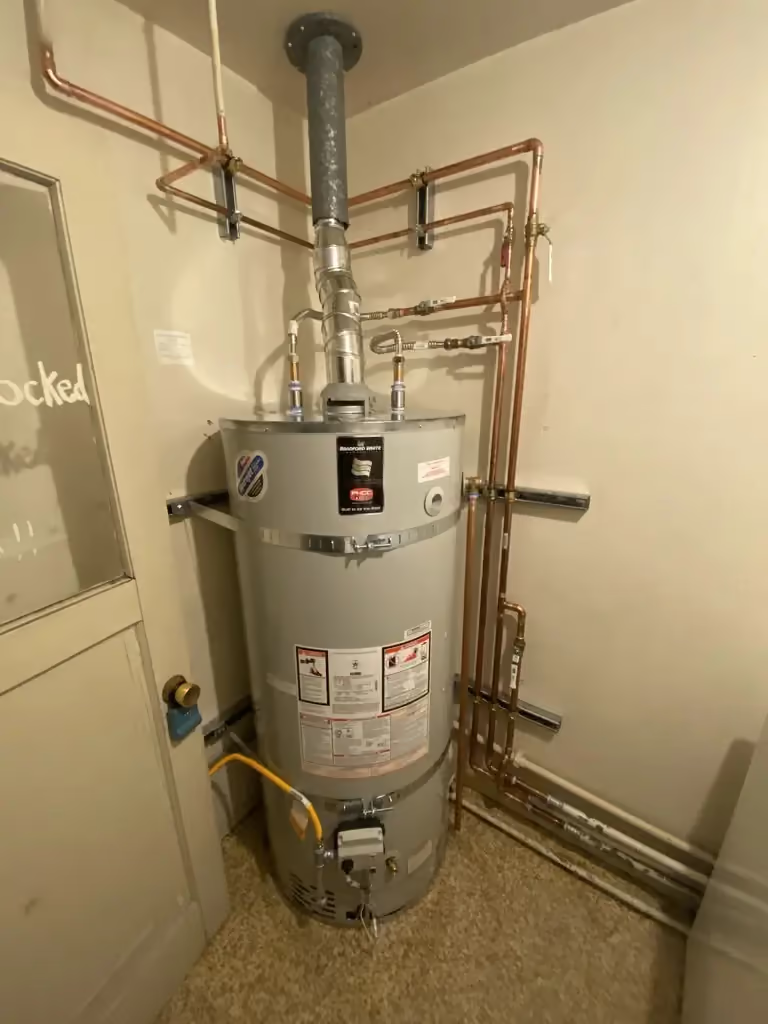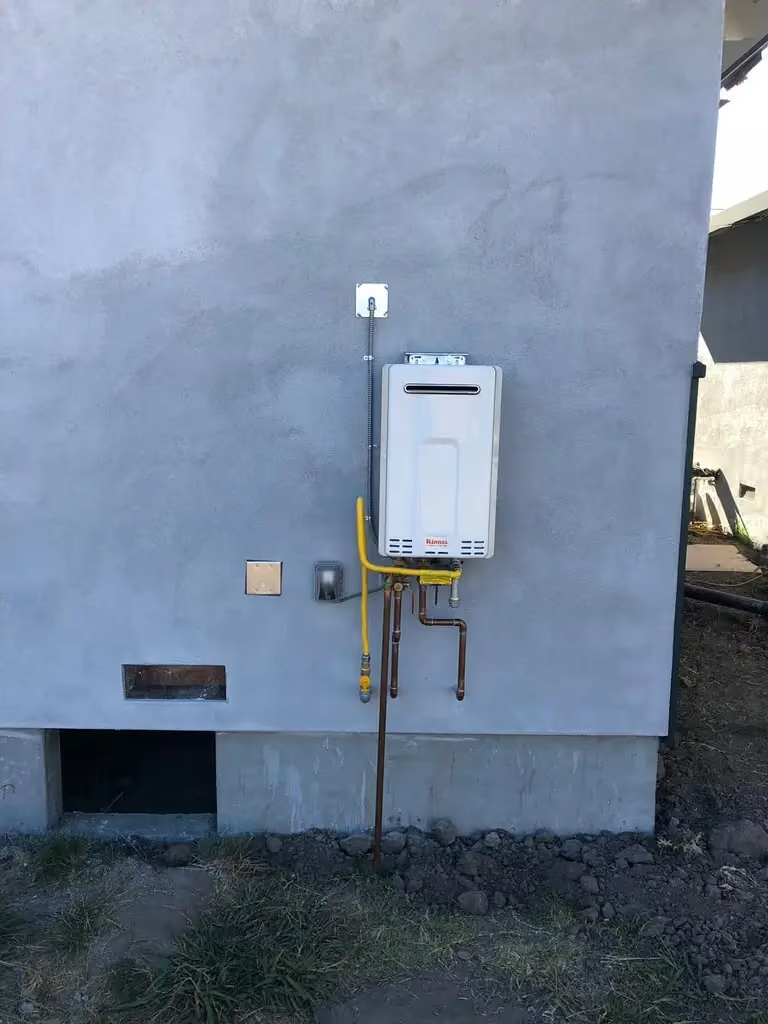
A tankless (demand) water heater warms water as it flows instead of keeping a tank hot. That cuts standby heat loss, but the unit has to be sized for the flow you actually use, vented and supplied with enough gas or power, and flushed on the schedule the manufacturer publishes. Hard water, which Soquel Creek Water District describes as hard to very hard in much of Capitola and Aptos, leaves scale in the heat exchanger. Santa Cruz County requires a plumbing permit to replace a water heater. Wade's Plumbing & Septic installs tankless and tank units. Quotes are free.
Quick answer
- Tankless units heat water only while a tap is open. ENERGY STAR calls these instantaneous heaters: they hold no more than one gallon of water per 4,000 Btu per hour of input.
- Size the unit by gallons per minute and the temperature rise from your coldest incoming water, not by matching the old tank's gallon label.
- Scale from hard water restricts flow through a tankless heat exchanger. The U.S. Department of Energy's Building America measure guideline says to flush the unit according to the manufacturer.
- Gas units often need a larger dedicated gas line than a tank heater. DOE notes that in most cases the in-house line serving the unit will need to be 3/4 inch.
- In unincorporated Santa Cruz County, replacing a water heater requires a plumbing permit. Confirm the rule with the city if you live in Santa Cruz, Capitola, Scotts Valley, or Watsonville.
How a tankless unit differs from a tank
DOE's Building America Measure Guideline: Transitioning to a Tankless Water Heater describes the sequence: cold water enters, a sensor sees flow, the burner or element fires, and water leaves at a set temperature. When flow stops, heat stops. A storage tank keeps a reservoir hot all day, which is the standby loss tankless units avoid.
ENERGY STAR certifies gas-fired instantaneous water heaters that meet a Uniform Energy Factor of at least 0.95, deliver at least 2.8 gallons per minute over a 67°F rise, and carry at least a 6-year heat-exchanger warranty and a 5-year parts warranty. Those numbers are the label threshold, not a promise about your utility bill. If you are choosing between repairing a tank and replacing it, start with repair or replace a water heater.
Tankless is not "unlimited hot water" in the sense of running every fixture at once. Capacity is a flow rate. If two showers and a dishwasher exceed the unit's gallons per minute at the temperature rise you need, the water at the tap cools. DOE says to size for the maximum hot-water flow demanded and for incoming water temperature, which is lower in winter.
DOE also notes a practical limit: the flow sensor may not see a trickle. A very low-flow faucet or shower head can fail to fire the unit. That is a sizing and fixture issue, not a defect to ignore at install.
Hard water in this county
USGS classifies water as hard at 121 to 180 mg/L as calcium carbonate and very hard above 180. Soquel Creek Water District, which serves Capitola, Soquel, Aptos, and La Selva Beach, publishes 2017 ranges that sit in the hard and very hard bands: about 150 to 370 ppm in Capitola and Soquel (41st Avenue to Park Avenue), 140 to 300 ppm in Soquel and Aptos (Park Avenue to State Park Drive), 150 to 200 ppm in Aptos and Rio del Mar, and 100 to 200 ppm in La Selva Beach. Other districts list hardness in their Consumer Confidence Report. On a private well, a lab test is the only way to know. Our hard water guide covers how to read those numbers.
DOE's tankless measure guideline is specific about scale. In a tank, minerals settle in the bottom and affect flow less. In a tankless heat exchanger, scale can restrict water, cut efficiency, and damage the unit. The same guide says tankless units should be flushed according to the manufacturer's instructions, and that some manufacturers require a softener to keep efficiency or coverage.
If you add a softener and the house is on septic, Santa Cruz County does not allow softener discharge into the septic system. Plan an approved drain with County Environmental Health first. Homes on sewer discharge through the sewer connection.
Gas, venting, and the cold-water line
A gas tankless burner is larger than a typical tank burner. DOE's guideline says a dedicated supply line may be needed, that the incoming gas line has to have the capacity for the required Btu input, and that in most cases the in-house gas line serving the unit will need to be 3/4 inch. Some houses also need a larger line to the meter. That is why a tankless conversion is not a same-footprint swap. Gas line repair is the service page for that piping.
If you smell gas, leave the building on foot and call 911 from a safe distance, then PG&E. Do not turn switches or use a phone until you are away. Gas piping work happens after the area is safe.
DOE also flags the cold-water supply. Tankless units typically want a 3/4 inch or 1 inch supply. An older house with a 1/2 inch main may not feed the unit well. The installer should check that on site.
Electric tankless units shift the constraint to the panel and the circuit. DOE treats gas and electric as different installation paths. Ask for the electrical or gas work to be in the quote so it is not a surprise after the old tank is out.
Permit
Santa Cruz County Building Permits says a plumbing permit is required when plumbing, gas or drainage piping, a fixture, or water heating or treatment equipment is installed, altered, repaired, or replaced, unless the California Plumbing Code or County ordinance exempts the work. The same page notes that a plumbing permit is required to replace a water heater.
A tank-to-tankless change replaces water-heating equipment and usually rearranges gas, vent, and water piping. That is permit work in the unincorporated county. Cities run their own building departments. The installer should pull the permit for the work they do.
What to decide before the quote
- How many showers, laundry loads, and fixtures might run at once, including a future bathroom or ADU. Adding an ADU is a septic question as well; see adding an ADU on a Santa Cruz County septic.
- Incoming winter water temperature and the setpoint you actually use.
- Whether the house is on Soquel Creek water, another district, or a well, and what the hardness is.
- Gas meter capacity, existing pipe size, and vent path, or the electrical panel if the unit is electric.
- Where the unit will hang. DOE recommends a central location close to the fixtures that use hot water.
Bring photos of the current heater, the gas meter or panel, and the space around the tank. Quotes are free. Pricing is flat rate, quoted on site before work begins.
Frequently asked questions
Do I need a permit to install a tankless water heater in Santa Cruz County?
In the unincorporated county, yes. Replacing a water heater requires a plumbing permit. Confirm the rule with your city if you are inside city limits. The installer should pull the permit for the work they do.
Does hard water mean I should not install tankless?
Not by itself. It means the unit has to be flushed on the manufacturer's schedule, and some manufacturers require treatment when hardness is high. Soquel Creek Water District describes its water as hard to very hard. A softener on a septic property cannot discharge brine to the tank.
Will a tankless unit run every fixture at once?
Only up to its rated flow at the temperature rise you need. Size it for the fixtures that actually run together. A unit that is too small cools down when two showers overlap.
How is tankless installation priced?
Flat rate, quoted on site before work begins. Quotes are free.
Sources
- U.S. Department of Energy, Building America, Measure Guideline: Transitioning to a Tankless Water Heater (PDF)
- ENERGY STAR, Water Heater Key Product Criteria
- USGS, Do you have information about water hardness in the United States?
- Soquel Creek Water District, Water Hardness
- Santa Cruz County Building Permits, When is a Plumbing Permit Required?
- Santa Cruz County Environmental Health, The Harmful Effects of Water Softener Discharge on Your Septic System (PDF)
Request a free quote
Wade's Plumbing & Septic provides tankless water heater installation and water heater installation for homes in Capitola, Aptos, Santa Cruz, and the rest of Santa Cruz County and nearby Santa Clara County communities. Quotes are free and pricing is flat rate, quoted on site before work begins. Get a Free Quote or call during office hours, Monday to Friday, 9:00 AM to 5:00 PM.